

What does a good organisational communication strategy look like in local government?
I think it looks something like this rather complicated-looking diagram.
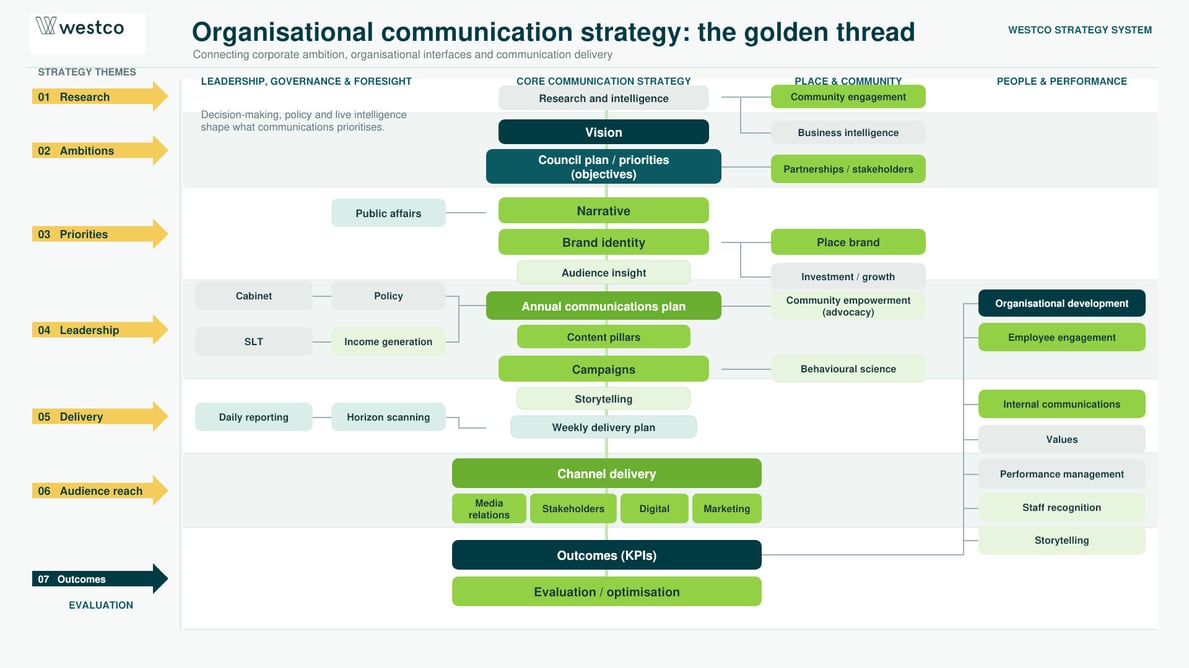
We often hear the phrase “golden thread”. It is one of those expressions particularly loved in local government: the idea that everything we do should connect organisational objectives to meaningful outcomes for residents and communities.
That sounds straightforward. In practice, creating that connection is incredibly difficult. Councils are complex organisations, working across dozens of services, responding to political priorities, changing public needs, financial pressures and events that rarely respect the corporate plan. Communication sits across all of it.
A good communication strategy therefore cannot simply be a list of campaigns, channels or things the communications team intends to produce. It has to show how communication will help the organisation achieve its ambitions... and how the many moving parts will work together to make that happen.
It starts with organisational purpose. What is the council trying to change, protect or improve? Which priorities most need communication to succeed? Not every corporate objective can become a communications priority, so the strategy must make choices. That is partly about reputation and trust, but also about improving lives, encouraging participation, supporting behaviour change, managing demand and helping services deliver better outcomes.
Those choices need to be informed by evidence: what residents, staff, partners and stakeholders think, feel and do; where trust is strong or fragile; which groups face barriers; what the data tells us; and what is happening in the wider political, social and media environment.
From there, the strategy should identify the audiences that matter most and the outcomes sought from each. “The general public” is rarely a useful audience. People have different experiences, motivations and needs. The clearer we are about whom we need to reach - and what we want them to understand, feel or do - the more purposeful communication becomes.
Then comes the narrative: a clear, credible account of what the organisation stands for, where it is going and why its decisions matter. This should not be a corporate slogan imposed on every message. It should provide a consistent story that services, leaders, staff and partners can recognise, adapt and bring to life through real people and tangible outcomes.
Only then should we decide how communication will be delivered: through campaigns, media, digital content, internal communication, engagement, public affairs, partnerships and direct service channels. The channel is not the strategy. It is one of the choices made in service of an audience and an outcome.
This is where the organisational “plug-ins” in the diagram become important. Think of communications as your organisational glue, both internally and externally. It needs meaningful connections with political and executive leadership, policy, transformation, service planning, performance, consultation and engagement, customer services, HR and emergency planning. It also needs to be involved early enough to shape decisions, understand risk and contribute insight, not invited in at the end to announce something already decided.
This requires two things to work – for organisations to recognise the importance of strategic communications (for example by giving it a place as the top table) and for communications itself to respond to that challenge with the right leadership skills and confidence.
The final pieces of the strategy are often the least glamorous, but they determine whether the strategy works: clear ownership, realistic resources, prioritisation, governance and measures that go beyond reach and engagement. Did people understand? Did confidence increase? Did behaviour change? Did service demand shift? What did we learn, and how will delivery be adapted?
None of this means creating a vast document that sits untouched until its review date. The best strategies are clear enough to guide everyday choices and flexible enough to respond when circumstances change. They give communications teams permission to prioritise, while giving leaders confidence that effort and resources are focused where they can make the greatest difference.
The golden thread is therefore not a single line. It is a connected system of choices, relationships and feedback. When those elements align, communication moves from being something the organisation produces to something that helps the organisation lead, listen and deliver.
- Westco runs peer-led ‘Communication MOTs’ for less than £3,500 to build your improvement plan.
Email: simon@westcocommunications.com
Author: